
Sex Offender Checks in Roanoke County
The Virginia Sex Offender and Crimes Against Minors Registry is the authoritative public source for a Roanoke County search. Virginia State Police operates it. The interface offers several paths because a searcher may know a person's name, an SOR number, or only a location. County and city filters can narrow a broad result set, while address-radius and map views help with Roanoke County community awareness around a home, school route, park, or other place.
Start with the least ambiguous fact available. An exact SOR number is direct. A full name can be checked against aliases and physical details. A location search should be repeated with nearby ZIP codes or map bounds when an address sits close to a jurisdiction line. Status filters may identify incarcerated, homeless, or civilly committed registrants. NSOPW adds a national layer for a person or location that crosses state borders, but its results depend on the participating jurisdictions that supply data.
Roanoke County Registry Boundaries
Roanoke County is legally separate from Roanoke City and Salem. A courthouse or jail can have a Salem mailing address while serving the county, yet registry geography still follows the actual jurisdiction and address. The Town of Vinton is within Roanoke County. Cave Spring and Hollins are Roanoke County communities rather than independent cities. Choosing “Roanoke” without checking the label can therefore produce the wrong scope.
For a Roanoke County-wide view, select Roanoke County. For an address near Roanoke City, Salem, or a town boundary, run an address-radius search and review the map instead of relying on one locality name. A Vinton-only search may omit nearby Roanoke County addresses outside the Roanoke County town line. Results should be tied to the profile's listed jurisdiction, address status, and latest verification data, not to assumptions drawn from a postal city name.
Note: Roanoke City and Salem are independent cities, so neither should be treated as a city inside Roanoke County.
How to Search the Virginia Sex Offender and Crimes Against Minors Registry
The official Roanoke County registry path allows a reader to switch among name, location, SOR-number, map, and related search controls. Accept the site's conditions, choose one search mode, and record the criteria used. Search spelling and Roanoke County geographic scope affect what appears. When checking a possible match, compare the profile's registry number, aliases, physical description, address or status, offense details, and verification dates rather than relying on a name alone.
- Open the VSP registry and review its conditions of use. Choose name, location, SOR number, or the map view based on the facts already known.
- Enter a surname and optional first name, or supply an address, city, county, ZIP code, and available radius. Select Roanoke County rather than Roanoke City when the county is the intended area.
- Use status filters and map or list controls where useful. Review all likely results, since spelling changes and aliases can affect a name search.
- Open the full profile. Match several identifiers, check the registration and verification information, and contact the listed authority if a material detail seems stale or incorrect.
| Field or control | Type | Required | Use |
|---|---|---|---|
| Search mode | Tabs | Yes | Name, location, SOR number, or map as exposed. |
| First and last name | Text | Conditional | Surname drives a name search; given name narrows it. |
| SOR number | Text | Conditional | Uses the registry identifier. |
| Street address | Text | Conditional | Centers a location-based search. |
| City and county | Text or dropdown | No | Select Roanoke County carefully and distinguish independent cities. |
| State and ZIP code | Dropdown and text | Location search | Virginia and a five-digit ZIP refine the area. |
| Radius | Dropdown | No | Available distances vary with search mode. |
| Status filters | Checkboxes | No | May include incarcerated, homeless, and civilly committed. |
| Map or list | Toggle | No | Switches between geographic pins and result rows. |
| Search and reset | Buttons | No | Runs or clears the selected criteria. |
Roanoke County Registry Redesign
Virginia State Police launched the redesigned public registry on October 31, 2023. The change is meaningful for Roanoke County searches because the interface brought county, city, address, ZIP, and SOR-number routes together with mapping and special-status filters. Those controls let a reader test a Roanoke County boundary or narrow results without centering the search on one person's identity.
The VSP registry interface is the primary place to perform that Roanoke County search. Its live registry screenshot was not available from the manifest, so the successful assigned images instead document Roanoke County access through the national search layer and the Virginia statutes and forms that govern access.
The National Sex Offender Public Website supplies the assigned neutral search view shown below.
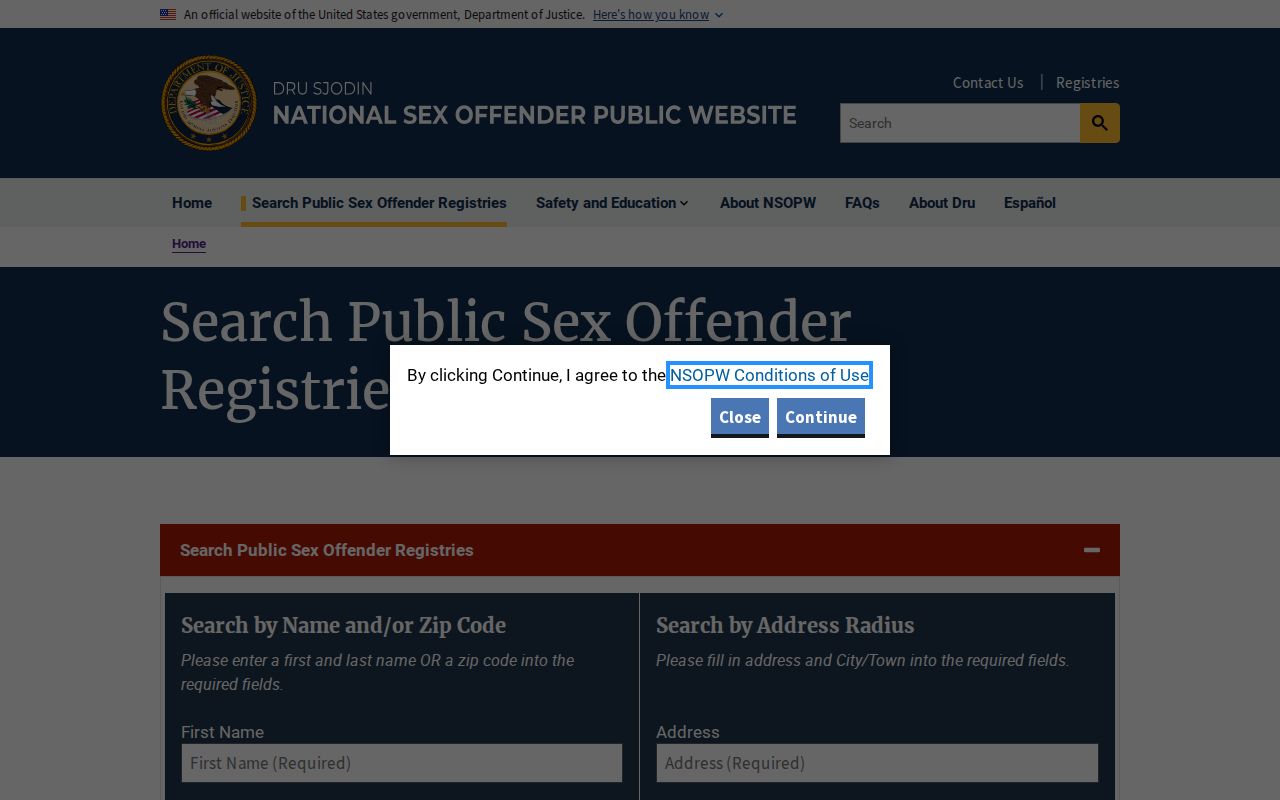
It is useful for cross-state coverage, but the Virginia profile remains the direct source for state registration details.
Inside a Registry Profile
A public Roanoke County profile combines identification, location, qualifying-offense, and compliance information. It may show a current photograph and the date it was taken, but a neutral search should never use the image as the sole basis for identification. Compare the SOR number, name and aliases, physical descriptors, jurisdiction, offense, conviction locality, address status, and verification dates. Fields can change as VSP receives updates from local law enforcement or VADOC.
| Registry identity | SOR number, full name, aliases, birth or age information, sex, and race as published. |
|---|---|
| Photo and description | Current photograph and date, height, weight, hair, eyes, and scars, marks, or tattoos where released. |
| Location | Residential and mailing information at lawful detail, plus homeless, incarcerated, or civilly committed status. |
| Other published places | Employer, school, and vehicle information when Virginia law makes those fields public. |
| Qualifying offense | Offense description and statute, conviction date and locality, and victim-age category if published. |
| Tier and status | Tier, compliance state, registration dates, and verification history. |
A listing reflects a qualifying conviction and a statutory registration duty. It does not state that a new offense occurred, predict present conduct, or replace an emergency call. Profile details should be read in the context VSP provides.
Roanoke County Registry Map Filters
The Roanoke County map and list views answer different questions. A list is efficient for reviewing names or profile rows. The map shows how listed locations relate to a selected address and can expose results across a municipal line. Filters for incarcerated, homeless, and civilly committed registrants matter because a pin may not represent an ordinary residential address. The profile status should always control the interpretation.
Radius options can vary with search mode. Record the distance used before comparing two result sets. A broader circle can include parts of Roanoke City, Salem, or nearby counties, while a Roanoke County filter may exclude an address just across the line. Recheck the Roanoke County location with both map and list controls if a known profile seems absent.
The Virginia registry chapter provides the legal structure behind publication, tiers, verification, and termination rules.
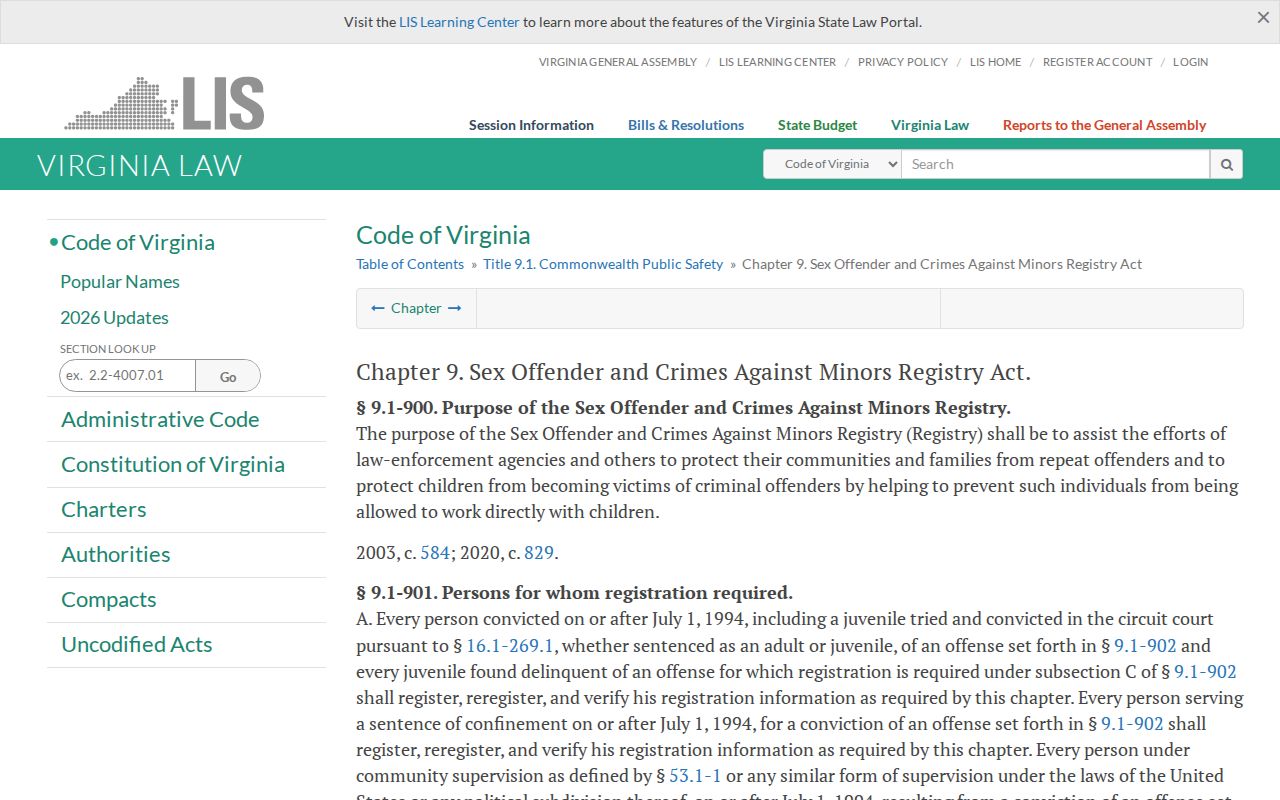
That source is more reliable than a generic chart because Virginia's duties depend on the actual offense, tier, court eligibility, and periods of confinement.
Virginia Registration Levels and Requirements
Virginia uses offense tiers, but its duration rules should not be reduced to a universal “10/25/life” formula. Tier I and Tier II registrants verify yearly during the birth month. A qualifying failure-to-register conviction can increase the required frequency. Tier III registrants and covered murder cases verify four times each year at three-month intervals. Roanoke County agencies forward registration data and updated photographs to VSP, with photographs renewed every two years.
| Virginia category | Verification | Duration or termination |
|---|---|---|
| Tier I | Yearly in the birth month under §9.1-904 | Continues until a court grants termination under §9.1-910; eligibility must be checked. |
| Tier II | Yearly in the birth month | Continues until qualifying court termination; confinement tolls the period. |
| Tier III | Four times yearly at three-month intervals | Lifetime duty under §9.1-908. |
| Murder or covered former offense | Quarterly or as specified | Lifetime duty under §9.1-908. |
VADOC physically verifies registrants under its control within 30 days of original registration, twice each year, and after an address change. For someone not under VADOC control, registration logistics should be confirmed with the Roanoke County territorial police agency and VSP. In Roanoke County, County Police is the local territorial agency, not the Sheriff's jail office.
Roanoke County Registry and NSOPW
Use VSP first for a Roanoke County, Virginia question. Its profile contains the state's current tier, offense, jurisdiction, compliance, and verification data. Use NSOPW when the search crosses a state line or when a past location may be outside Virginia. NSOPW queries participating registries and is a useful second layer, but its result is only as current and complete as the source jurisdiction's feed.
| Source | Best use | Key limit |
|---|---|---|
| VSP registry | Virginia name, SOR number, county, city, address, radius, and map searches | Virginia scope; geography must distinguish the county from independent cities. |
| NSOPW | Cross-jurisdiction name and location searching | Depends on data supplied by participating jurisdictions. |
The VSP forms directory also identifies official registry forms and state processes.
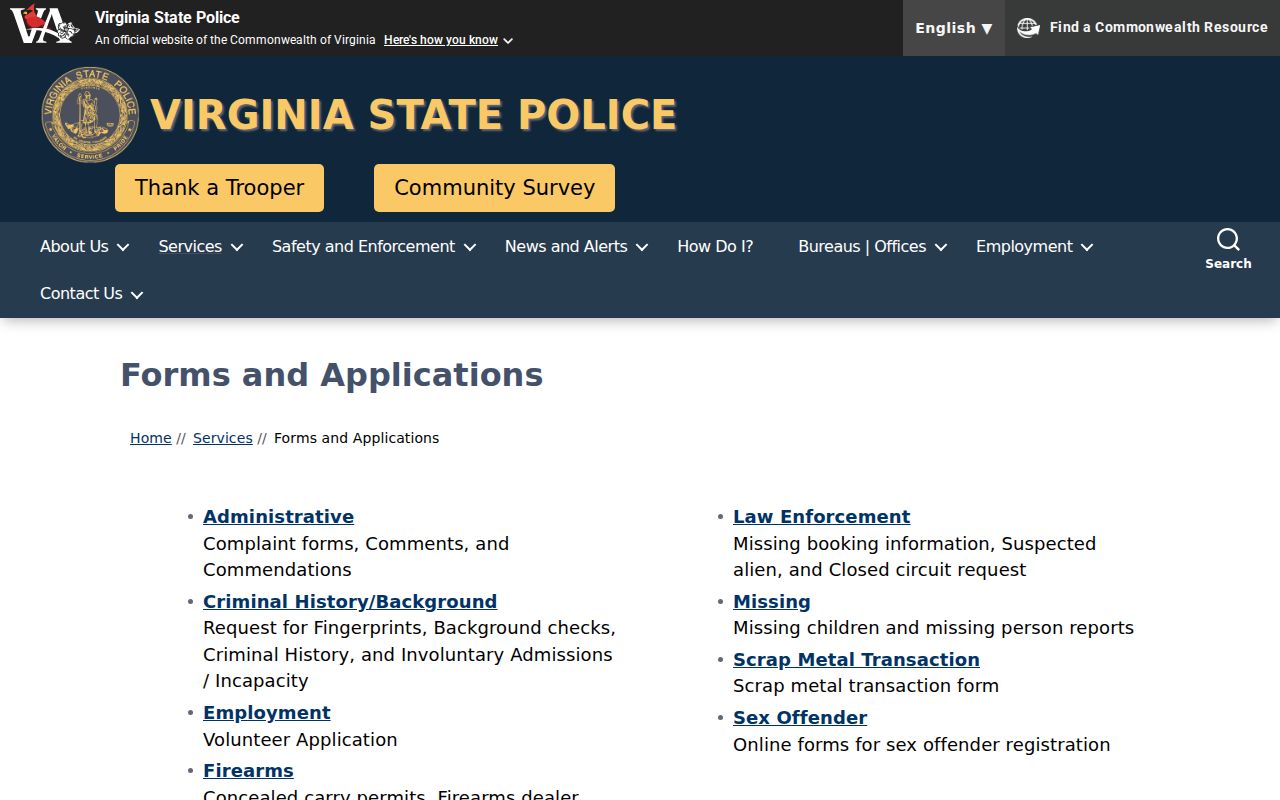
Forms serve formal state procedures; they do not replace the free public registry search for ordinary community awareness.
Community Notification and Lawful Use
Roanoke County registry information is published for public safety. A Roanoke County resident can use it to understand a listed conviction, check a location, plan a family conversation, or report a suspected compliance problem. The information does not authorize confrontation. Do not threaten, harass, intimidate, trespass, retaliate, or use a profile as a reason for vigilante action. If there is an immediate threat, call 911 rather than trying to investigate it personally.
Use registry records lawfully: Virginia Code §9.1-913 warns that misuse of registry information to intimidate or harass can lead to criminal or civil consequences.
The official registry publication and misuse statute states the public-safety purpose and legal limits.
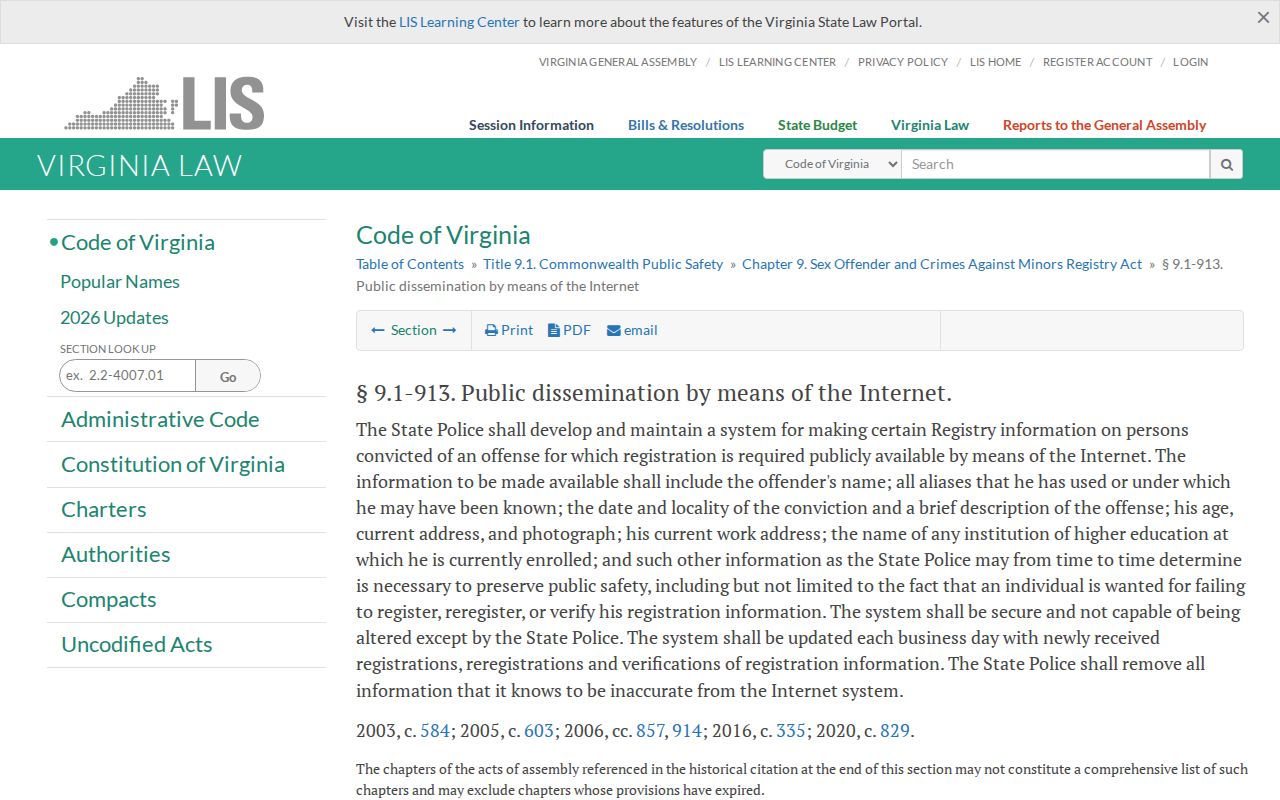
The statute makes clear why profile facts should support measured safety choices and accurate reporting, not punishment by members of the public.
Reporting Roanoke County Registry Gaps
If a Roanoke County profile appears outdated or suspected noncompliance is observed, report the specific concern to Roanoke County Police at 540-562-3265 or to the VSP Registry at 804-674-2825 or sor@vsp.virginia.gov. The official County Police page confirms the responsible local department. Supply the profile or SOR number, the field at issue, and the factual basis for concern.
Local police and VSP are the proper contacts because County Police is the territorial law-enforcement agency and VSP operates the registry. The county's Citizen Services page lists local public-safety channels, while the Roanoke County government portal verifies current department routing. The Sheriff runs the jail and courts functions, but the research does not establish a separate Sheriff registry list or app. A delayed map pin or stale field also does not establish a new crime. Report it for official review.
Virginia's dissemination rules distinguish state criminal-history records from the public registry. The criminal-history dissemination statute illustrates that separate legal layer.
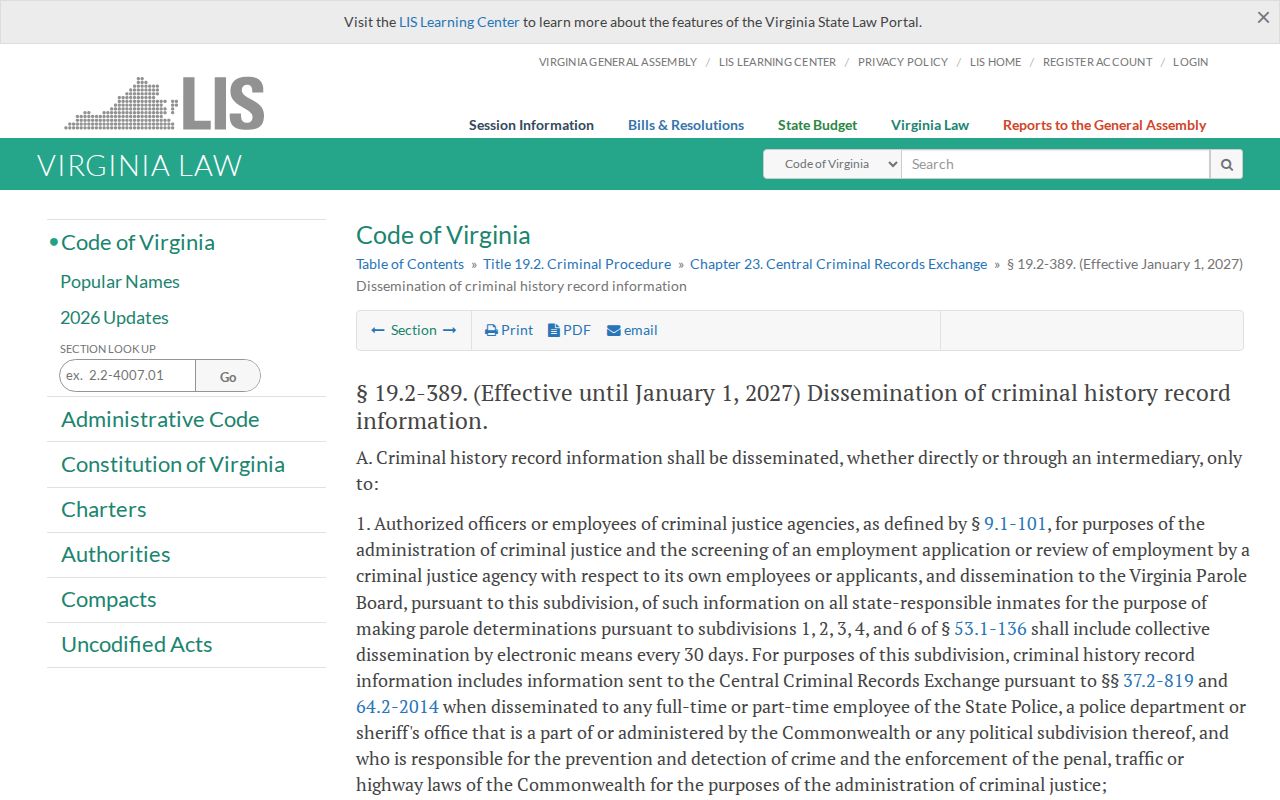
A public registry search and a formal criminal-history request are different products, even when a qualifying conviction may appear in both.
Note: A registry profile records a qualifying conviction and current duty; it does not predict whether a person will commit another offense.